Kempo Dankan is a gymnastic-martial discipline whose most ancient cultural principles go back to mid-Asiatic Shamanism and to the oriental Indian and Chinese tradition, starting from the 3rd millennium BC. It takes inspiration from Tapas exercises, Karmayoga practices, and the I Ching philosophy of the first legendary Chinese emperor, Fu Hi.
In detail, Kempo Dankan takes its origin from the method elaborated by three eminent Chinese Masters in the 17th century BC: the Zen monk Kueh Yuan; the Taoist monk Li Kieng, the most recognised authority of the National schools (Nei Kia); and Pai Yu Feng, an expert fighter of the popular schools. In the Shao Lin Monastery they exchanged their different technical-theoretical experiences to reach a widespread martial knowledge of the tradition of that time. After months of hard work, they elaborated a new and singular method, distinguished by its technical and cultural eclecticism from the innumerable local and national schools of different inspiration.
Descending from these legendary and historical assumptions, in 1971 Master Michele Masucci — Bujintsu Kempo and Shotokan Karate black belt — codified the Kempo Dankan discipline and founded the CISOK Federation, which assembled the first trainees.
The modernity of this school combines traditional principles with a valid educational, holistic, gymnastic-martial programme inspired by the different philosophical features of Brahmanism, Taoism, Confucianism and Zen Buddhism.
The school is still guided by Michele Masucci, its founder, who was recognised as General Teacher in 1992 for bringing Kempo Dankan into the international context of Martial Arts, and was awarded the 9th-grade Red Belt by the IBF — International Budo Federation. In 1996 he was elected vice-president of the World Martial Arts Federation–CSEN/CONI, which recognised him with the 10th grade in 2002.
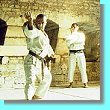
A Kempo Dankan Master attends his pupil in training in an ancient structure built in the 16th century BC. The Method applies the classic tradition of the old Chinese school and the principles of Zen Buddhism in a modern discipline.